
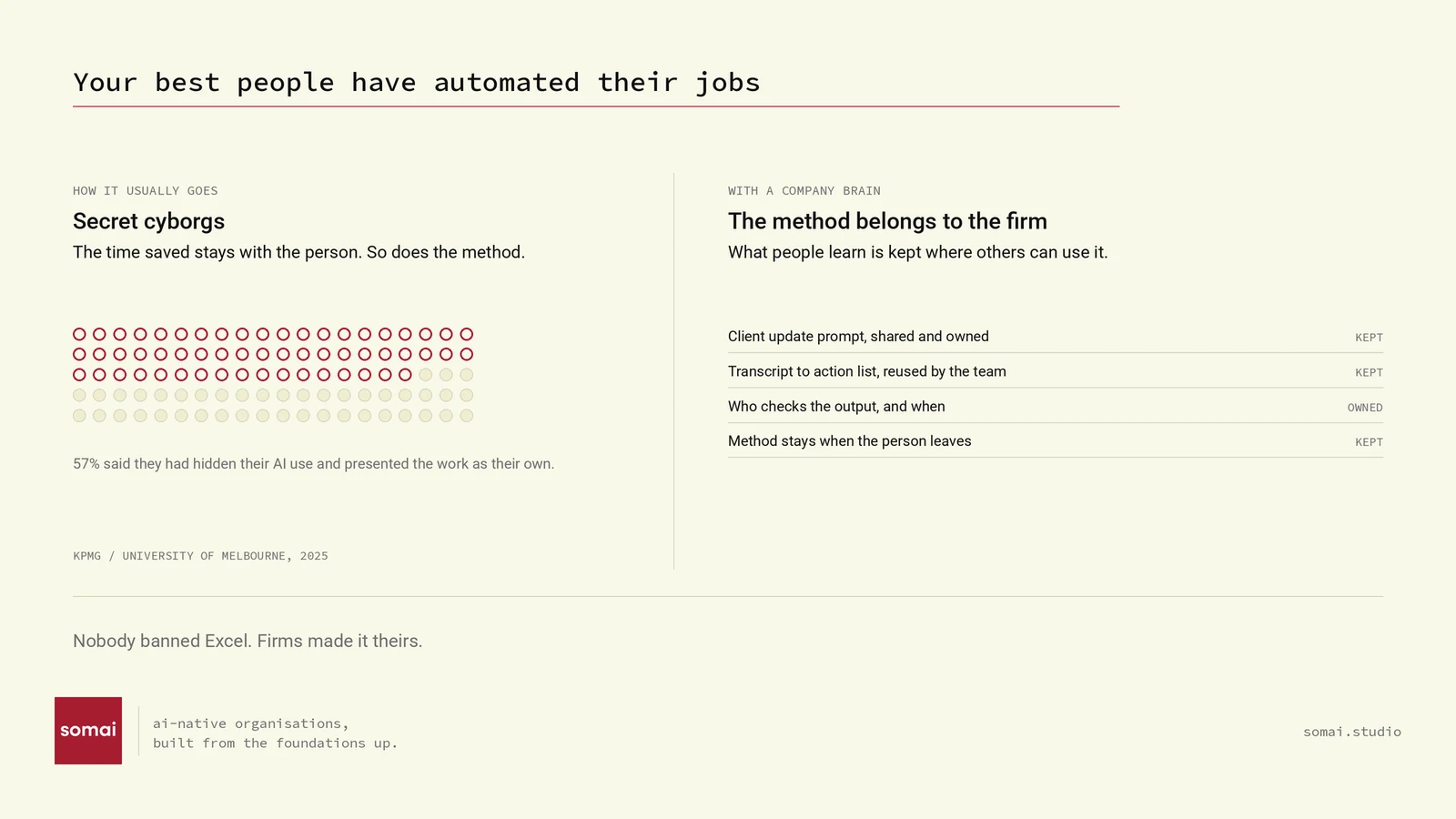
Somewhere in your business, someone has automated a large part of their job. They draft the weekly client update in ten minutes instead of two hours. They have a set of prompts that turns a messy call transcript into a clean action list. They haven’t told you.
From where they sit, that is the sensible choice. If they mention it, they might be asked to do more. They might be told to stop. They might be thought less of. Saying nothing costs them nothing.
Secret cyborgs
Ethan Mollick, who studies AI and work at Wharton, has a name for these people. He calls them secret cyborgs: staff who use AI to do their work without telling the organisation.
They are not rare. In KPMG and the University of Melbourne’s 2025 study of trust in AI, 57% of employees said they had hidden their use of AI and presented AI-generated work as their own.
None of this needs bad intent. People have always found easier routes to get the job done. Spreadsheets, macros and email templates all started as someone’s private shortcut. AI is the next in that line. The difference is how much of the job it can reach.
We have been here before, with spreadsheets
In 2012 JPMorgan lost around $6bn on a set of trades that became known as the London Whale. The bank’s own task force found many causes, including a flawed trading strategy. One of the operational problems it named was a risk model that “operated through a series of Excel spreadsheets, which had to be completed manually, by a process of copying and pasting data from one spreadsheet to another.”
The loss did not happen because of a spreadsheet. But it ran partly through one, built and maintained out of sight of the people who were meant to check it.
Unseen tools doing important work is an old risk. What has changed is where those tools live. A spreadsheet at least sits on the company drive, where someone could open it. An AI workflow sits in a personal account on someone’s phone.
What the business loses
The first loss is the gain itself. If a person saves eight hours a week and nobody knows, those eight hours belong to them. That is the incentive working as designed. The firm pays for a role and gets the same output it got before.
The second loss is the know-how. The prompts, the steps and the judgement about when the output can be trusted all stay in that personal account. When the person leaves, the method leaves too. You can rehire the role. You can’t rehire the capability, because nobody else ever saw how it worked.
“If the work gets done, why should I care how?”
This is the strongest objection, and it deserves a straight answer. If the client update is good and on time, why does it matter whether a person or a prompt drafted it?
Because you are paying for output you can’t check, repeat or keep. The same KPMG study found that 66% of employees rely on AI output without evaluating it, and 56% say they have made mistakes in their work because of AI. Nobody reviews work they don’t know was AI-assisted, so nobody catches those mistakes until a client does.
And because the next person in the role starts from scratch. The firm keeps paying to rediscover a method that one of its own people had already worked out.
Nobody banned Excel
The answer to private spreadsheets was never to ban them. Firms learned to make them part of how the company works: on shared drives, owned by someone, checked by someone else.
AI needs the same move. The method has to live somewhere the business can see it, use it again and improve it. That means an approved route good enough that people choose it over the free one, and a shared place where what they learn is kept.
They almost certainly are using AI. The useful question is whether any of what they have learned belongs to the business yet.
Next in this series: why banning AI just moves it to their phones.
Sources: Mollick, “Detecting the secret cyborgs” (One Useful Thing, 2023); KPMG and University of Melbourne, Trust in AI (2025); Report of JPMorgan Chase & Co. Management Task Force regarding 2012 CIO losses (2013).