
What it is today
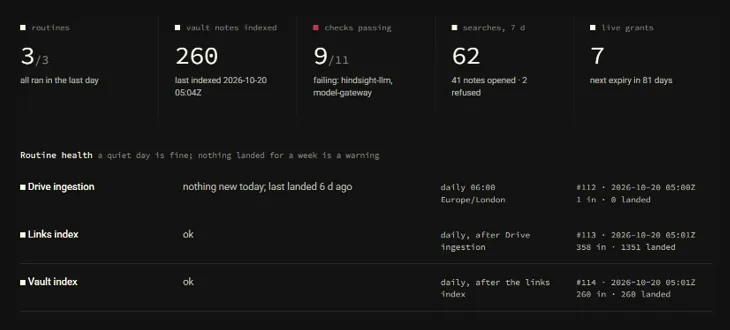
The governed version of our brain took in its first documents on 9 October 2026, and answered its first question from Claude on 11 October. Today it reads our shared drive every morning, from a register of sources we approved one by one. We file notes into it and ask it questions from the AI assistant we already use, and a governance panel shows what came in, what was kept out and how the daily checks stand.
It is early, and deliberately small: one founder connected so far, more sources to come. That is the point of running it first. We find the problems on our own business before we find them on yours.
Against the design, part by part: seven of the twelve parts run in ours, two run in part, and two are designed and not built yet. The twelfth is the work before a build, and that is the question audit, offered now. The drawing is the one on what a company brain is made of, marked.
Nothing goes in by accident
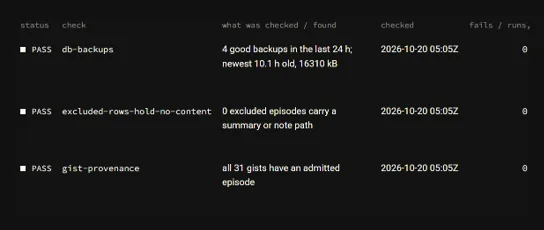
Every source was approved before anything was read from it, each with an owner, a ceiling on how sensitive its contents may be, and a date by which it must be reviewed again. The automatic checks can keep things out. None of them can let anything in: something is in the brain because a person admitted it, never because a model failed to object.
It has been tested in both directions. An attempt to file into an area the filer had no permission to write to was refused. And once, a file of code got in before the rule against code files existed. It was taken out, and the record that it was admitted stays, because that record only ever grows.
Permissions, checked before every answer
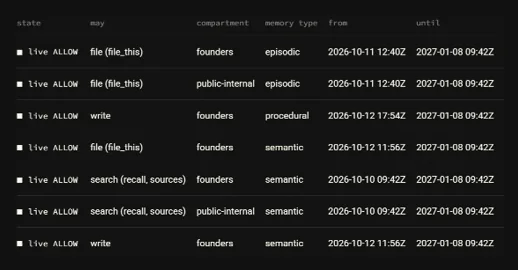
Before the brain answers anyone, a separate policy service checks what that person may see. If the check cannot run, the answer is refused rather than given. A request made as a co-founder whose access had not yet been granted was refused. A test identity with no permissions at all is checked in every build, and must get nothing.
Permissions also end. Every grant carries an expiry date, and the tests prove a grant stops working one second after it expires. Our own first grants run out in January 2027 unless someone renews them.
Rebuilt from plain files
What the brain knows is held as plain files with a full history; the database and the memory are built from them. On 11 October we tested that claim: we built a second copy of the memory from the files at the same version and compared the two.
Every document matched byte for byte, 11 of 11. All 1,100 links matched. Every note was found by searching its own title, and six everyday questions cited the same notes from both copies.
The memories themselves were equivalent, not identical: the model that reads each note drew out 40 facts where the live copy holds 44, so in a few harder searches a secondary note moved up or down. That is the honest limit of a rebuild, and we record it. Restoring from a backup should give back the exact memories, but we have not rehearsed that yet.
Erasure, rehearsed
On 10 October we planted an invented person in every place the brain keeps anything - the files and their history, a proposed change, the memory and the database - and then erased them. Every store we control came back clean, checked by a different route from the one that did the deleting.
The rehearsal also found two places the design had missed: the memory service kept its own copies of what it was sent, and its logs recorded what was asked. Both are now switched off.
What survives an erasure, listed exactly: the code host keeps old versions reachable by their identifier until its support team removes them; cloud logs keep entries for up to 30 days; database backups hold deleted records until they expire; and the AI model provider's logs may hold the text. The last two we have not yet verified. An erasure certificate that does not name what remains is not one.
Checked every morning
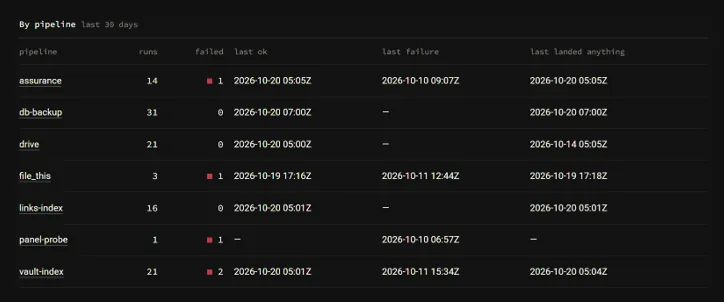
A set of checks runs every morning and records its result, pass or fail, on the governance panel:
- whatever was kept out still holds no content;
- every note traces back to where it came from;
- the links and the search index match the files;
- every approved source is inside its review date;
- nothing shaped like a password or a key has got in;
- the route to the AI models is answering.
The rule we build to is that every check gets a planted failure before it is trusted: a check that has never failed has not been tested. The first full run failed too, on a fault in how the checks recorded their own results. It was caught, fixed and run again.
What we don't claim yet
No accuracy figure: we have not yet run the comparison against a fixed set of real questions that would earn one. No certification: none has been applied for. And not everything in the design is running in our own brain yet. When it is, this page will say so, with the date and the evidence.
Start with a conversation. Book a discovery call, or see how the brain understands and how it connects.