Your business has intelligence. It just isn’t connected.
What we hear most, in one form or another: we’ve bought the AI,
it’s impressive, and it doesn’t know anything about us.
That is because what your company knows is spread across people,
teams, systems and, increasingly, AI. Sales sees one part, finance
another, operations another, and every AI tool sees only the context
it has been given.
As AI moves from helping people to making decisions and taking
action, those disconnected pieces become a bigger problem.
The missing layer between your business and your AI tools is what we
call the company brain.
See what connected context changes.
Explore the questions your business asks every day, and see what happens
when the relevant context across your company is connected.
The question
What somai reveals
The information was already there. The insight emerges when the context
connects.
§ 02The somai solution
Connect your company. Give AI the context to act.
somai builds a company brain. It
connects what is already spread
across your business, holds it as a knowledge graph that people and
AI work from together, and gives AI the controls to decide and act
within your rules.
your systemsand the rest of what you run
the company brain
store · knowledge graph · context
your people and their AI toolsand whatever you move to next
Connect
Connect your existing systems, data, documents, knowledge and communications.
You control what AI can reach, what it is allowed to do, and you can
see why it answered the way it did.
You own it, either way.
We hand it over, or we run it for you, on your own servers or in your own cloud account. The database is disposable; the record is not: plain files you can rebuild from, or take in-house at any time. And every permission you grant expires unless you renew it.
Controls are infrastructure, not prompts.
Claude, ChatGPT, Copilot and Gemini are built to connect through the open standard AI assistants use, under the same rules. What each may see is enforced by the system, not asked of the AI. Your systems stay in place.
Nothing goes in by accident.
A named person approves every source before anything is captured. Classification may only exclude, never admit: nothing is in the brain because a model failed to object.
It is built to say when it doesn’t know.
Every answer carries its source. When the evidence is not there, it is built to say so, and why; a count or a total gets a checked query or a refusal, never an estimate.
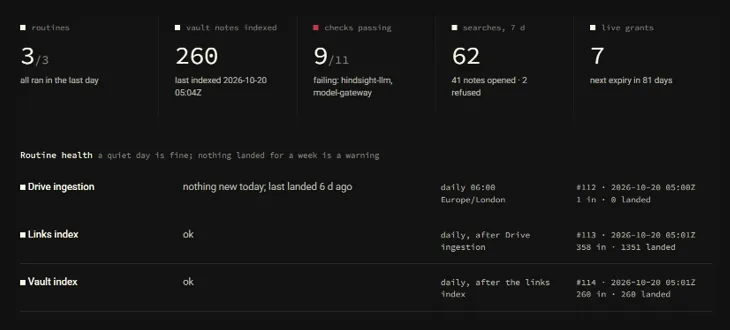
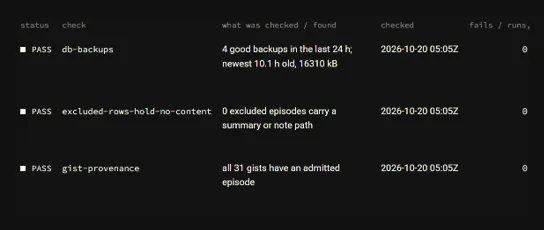
We do not publish client names, logos or quotes. What we can show is
how we run our own company brain, every day.
How we run ours →
§ 05How it lands
How it lands
01 - Blueprint.
A discovery call, then the question audit: about two hundred real questions from your business, answered in writing, so you know what a company brain would and would not do for you before anything is built. A small fixed fee, credited against what follows. The question audit →
02 - Build.
The brain is built for your company: your knowledge organised, your systems connected, and real answers coming back with their sources. On your own servers or in your own cloud account. Bounded work, measured in weeks, with senior people working alongside your team.
03 - Handover, or we run it.
We hand it over and your team runs it, with the files, the connections and the know-how to keep it current. Or we run it for you. Either way it is yours, and you can take it in-house at any time. Two ways to have it →
04 - Grow.
Add use cases, one at a time: the accounts you serve, the cash you are owed, the obligations you have. Every one reads the same brain, so each one you add makes the others sharper.
“We have a shared drive and an AI copilot. Isn’t that a company brain?”
No, and it shows the first time someone asks a hard question. A copilot on a shared drive searches whatever is stored: drafts, duplicates, the version that was withdrawn in March. A company brain holds what someone has decided is true, with an owner and a source on every entry. One is a search box over your mess. The other is a single source of truth.
“Are we too small for this?”
The honest test is not headcount. It is whether the same questions get answered from scratch every week, whether knowledge leaves when people do, and whether AI tools you’ve paid for have quietly disappointed. If none of that is true yet, you don’t need us - and we’ll say so.
“Which AI tools does it work with?”
The ones you already use, and the ones you’ll switch to next year. The connection layer speaks the open standard AI assistants understand, so the brain outlives any one tool choice.
“Who can see what?”
You decide, and the brain enforces it. Who may see what is built into the system, not into a polite instruction the AI is asked to follow. Every question, answered or refused, is recorded with who asked it and which sources the answer drew on. And some things should never go in at all; we agree that list before anything is captured, not after.
“Where does it run?”
On your own servers, or in your own cloud account, which we can set up for you. Either way it is yours: plain files, an index that rebuilds from them, and nothing locked into any vendor, us included.
“Where does our data go when AI answers?”
The brain stays on your own servers or in your own cloud account. When AI reads or answers from it, the passages it needs go to that model’s provider, through your own business account with them, not ours, and we help you choose terms that keep your data out of training. For your most sensitive material, we can build it on a private or open-source model that runs in your own environment instead.
“What about personal data and GDPR?”
The first rule is to keep it out: some kinds of personal data never go in, and we agree that list before anything is captured. Everything else comes only from sources a named person has approved. When someone’s data has to be removed, the brain is built to erase it from the record and from everything built from it, and to list anything that remains, such as a backup still running out its time. We have rehearsed that on our own brain. Erasure, rehearsed →
“What happens when someone leaves?”
Their access goes and their knowledge stays. The brain is built to use your own sign-in, so closing their account closes their access, and every permission expires anyway unless someone renews it. What they wrote stays, with their name on it, because it belongs to the company. That is half the point of having one.
“What won’t it do?”
Some things, by design. It won’t answer everything: a count or a total gets a checked query or a refusal, and before you sign we tell you how many of your real questions fall outside what it can answer. It won’t turn your questions into database queries on the fly, build its links by having AI read everything, or switch on an agent without a named owner. And it won’t claim an accuracy figure until your own questions have measured one.
“Who keeps it current?”
A brain nobody curates goes stale, so we agree who does before we build. If we hand it over, your team does, with what it needs to do it. If we run it for you, we do: new material taken in under your rules, every source reviewed on its own date, mistakes corrected at the source.
“What does it cost, and what keeps costing?”
There are two ways to have it. We build it and hand it over for a fixed fee, and afterwards nothing keeps billing but your own cloud and AI usage. Or we build it and run it for you: a set-up fee, then a monthly fee set by the size of your company. Either way you own it. Two ways to have it →
“What happens first?”
A discovery call, then the question audit: about two hundred real questions from your business, answered in writing with what a company brain would answer well and what it would not. Nothing is built until you have read it. The question audit →
§ 07Studio
A studio of senior operators. No juniors, no offshore, no associates in
the room.
somai is led by two operators who have built and run companies
themselves: James spent over a decade building DirectID, and Matt
built new businesses inside Google. The people you meet are the
people who do the work.
Every brain is designed for the company it serves, so there is no box
to buy. What you choose is who runs it once it is built.
We build it. You run it.
For companies with the technical people to look after it.
We design and build your brain, connect it to the systems you already run, and train your team to run it.
It runs on your own servers or in your own cloud account.
Price A fixed fee. Afterwards, nothing keeps billing but your own cloud and AI usage.
We build it and run it for you.
For companies without the people to run it, which is most. The person who would look after it is hard to hire and hard to keep. Instead of hiring them, you get a team.
Everything in the first. Then we keep it current, trusted and useful: new material taken in under your rules, checked every day, fixed when something breaks, and new use cases added when you’re ready.
It still runs on your servers or in your cloud account, and it’s still yours. Take it in-house at any time.
Price A set-up fee, then a monthly fee set by the size of your company.
A discovery call comes first: what your business needs to know, where
that knowledge lives today, and whether a company brain is the right
answer. If it is not, we will say so.
Then the question audit.
We collect about two hundred real questions from your business and
tell you, in writing, which ones a company brain would answer well,
which need a different tool, and which nothing can answer until other
work is done. It is a small fixed fee, credited against the build or
the service if you go ahead.
How the question audit works →