
This is an illustrative composite. It describes no client and uses nothing from a client’s record.
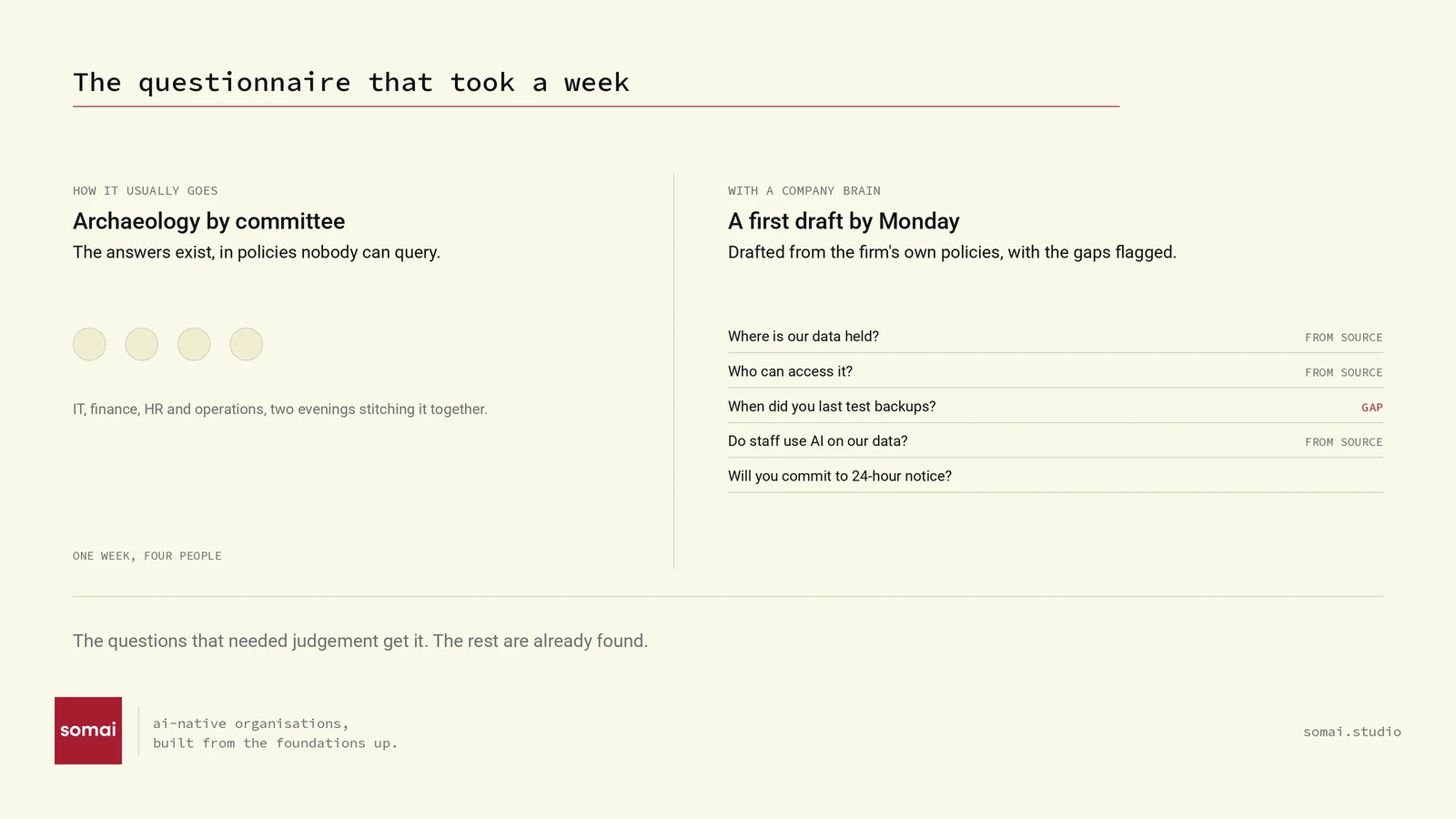
It arrives at 4pm on a Friday, attached to a renewal. Ninety-two questions from a client’s procurement team. Where is our data held? Who can access it? When did you last test your backups? Do your staff use AI tools on our information, and under what controls?
The head of operations at a 180-person professional services firm has seen this before. Last time it took a week and four people. The IT lead answered the technical questions, the finance director found the insurance certificate, someone in HR dug out the training records, and she spent two evenings stitching it together and chasing the gaps.
None of the answers were new. The firm had policies on all of it. The policies were in a shared folder, in three versions, written by people who had since moved on.
The knowledge exists. It just can’t be asked anything
This is the strange part of most compliance work. The firm is not short of information. It has an access policy, a retention schedule, a business continuity plan, a list of subprocessors and minutes from the meeting where the AI policy was agreed.
What it doesn’t have is a way to ask any of them a question. So every questionnaire becomes an exercise in archaeology, run by whoever is least able to say no.
This time the first draft is ready by Monday morning
With a company brain, the questionnaire goes in and a first draft comes out. Each answer is drafted from the firm’s own policies, and each one links to the passage it came from.
Most of the ninety-two come back answered. A handful come back marked as gaps: the backup test date isn’t recorded anywhere, and the subprocessor list was last approved eighteen months ago. Two come back flagged for a person, because they ask for a commitment the firm hasn’t made yet.
The head of operations spends Monday morning on those, not on the other eighty. The questions that needed judgement get it. The ones that only needed finding are already found.
The questions that needed judgement get it. The ones that only needed finding are already found.
The junior’s question matters more than the client’s
On Tuesday a trainee asks something smaller. Can she paste a client’s draft contract into an AI tool to summarise it, and which policy says so?
In most firms that question goes unasked. She would either do it and hope, or not do it and lose an hour. Either way, nobody would know.
Here she asks the brain. It points her to the firm’s AI policy, quotes the paragraph on client data, and tells her which approved tool she can use. If the policy didn’t cover it, she would be told that too, and the gap would land on the list of things someone needs to decide.
That is what compliance looks like when it can be asked. The rules are the same as before. What changes is that people can find them at the moment they need them.
Rules can only be followed if people can find them
The usual response to a slow questionnaire is a better template. It helps a little. The week spent answering is the smaller cost. The larger one is that the firm’s own rules are effectively invisible to the people expected to follow them, and only become visible when an outsider asks.
The same knowledge that answers a client in an afternoon also answers the trainee in a minute. One governed record of what the firm has decided, readable by the tools its people already use, with rules about who can see what.
When did someone in your firm last have to guess what the policy said?
See the compliance use case.