
Picture a problem spotted by someone on the front line of a 300-person firm. A client is unhappy. A supplier has started missing dates. A project is drifting over budget in a way the monthly report doesn’t show yet.
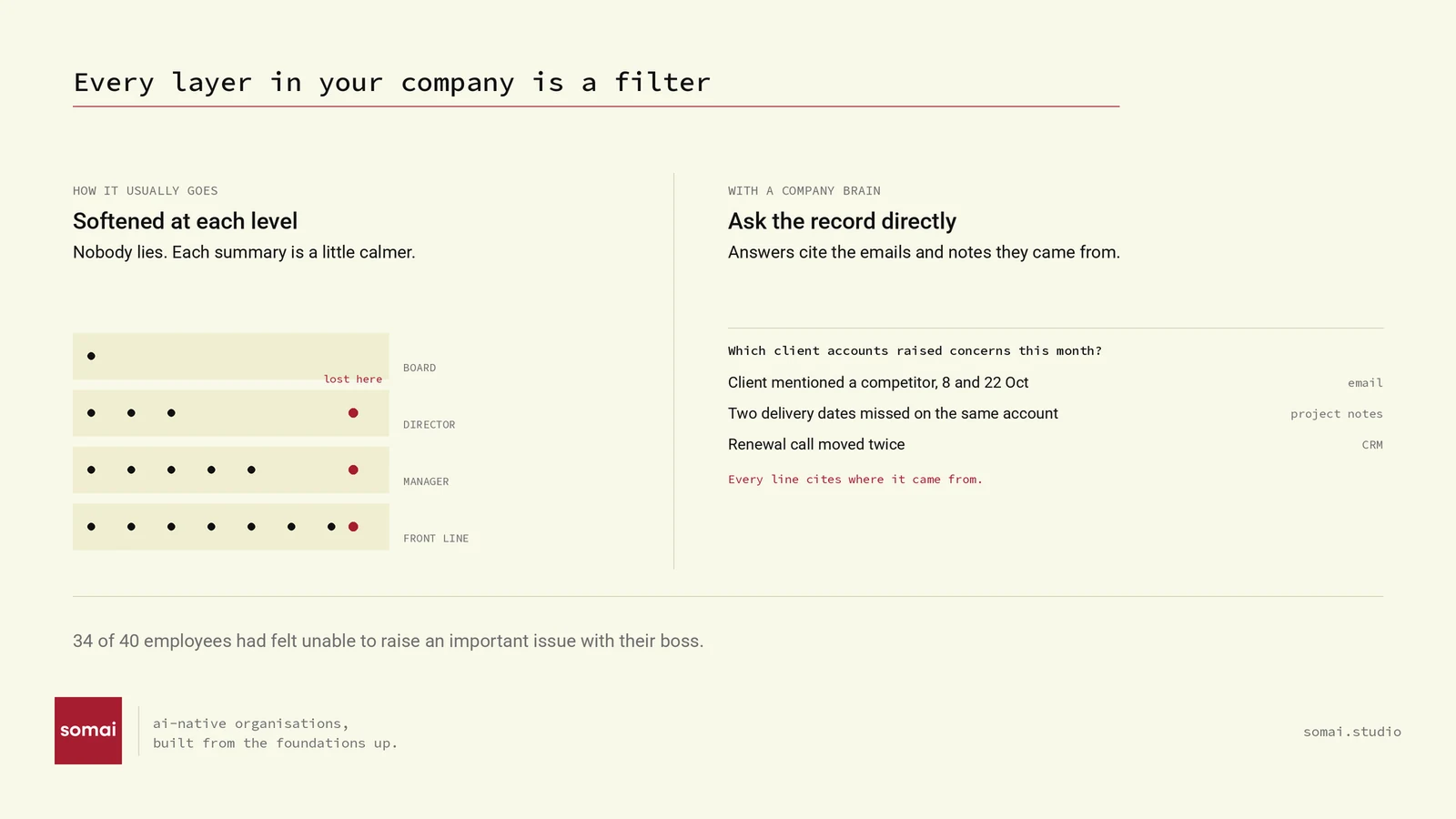
That person tells their manager. The manager tells the director, in a shorter version, with some context added and some removed. The director mentions it at the leadership meeting, as one item among twelve. By the time it reaches the person who could act on it, “the client is talking to a competitor” has become “some friction on the account, being managed”.
Nobody lied. Every person in the chain made a reasonable call about what to pass on. That is the problem.
People don’t like carrying bad news
Psychologists have a name for this. In 1970 Sidney Rosen and Abraham Tesser described what they called the MUM effect: people are reluctant to pass on unwelcome information, even when it isn’t about them and even when the person receiving it needs it.
Three decades later, Frances Milliken, Elizabeth Morrison and Patricia Hewlin asked employees directly. They interviewed 40 people working across a range of industries. Thirty-four of them, 85%, said that at least once they had felt unable to raise an issue or concern with their boss, even though they thought it mattered.
The reasons were ordinary. The most common was the fear of being seen or labelled negatively. The next was the worry of damaging a relationship. Others thought speaking up would make no difference.
None of this needs a bad culture. It needs people, a hierarchy and a reason to be careful. Most firms have all three.
When the filtering is fatal
The most studied example is the loss of the space shuttle Columbia in 2003. During the flight, engineers knew a piece of foam had struck the left wing on launch. Their analysis of the damage relied on a model calibrated with debris far smaller than the real thing. The accident investigation board put the piece at up to 640 times larger by volume than the test pieces, with its best estimate at 400 times.
That doubt existed. It just didn’t travel. In the board’s words, “the assumptions and uncertainty embedded in this analysis were never fully presented to the Mission Evaluation Room or the Mission Management Team.”
The board also traced three separate requests from engineers for images of the damaged wing. All three, it found, “were ultimately dismissed by the Mission Management Team.”
At each step someone summarised, and in each summary the uncertainty got smaller. The people at the top made their decision on a version of the facts that the people at the bottom would not have recognised.
Your firm is not NASA, and the stakes are rarely that high. The mechanism is the same.
More meetings won’t fix it
The usual answers are cultural. Open-door policies, skip-level meetings, anonymous surveys and a leader who says they want to hear bad news. These help, and they’re worth doing. But they all depend on someone choosing to speak at the right moment, to the right person, in the right words. The MUM effect is what happens when they don’t.
There is a second, quieter answer. Change what the people at the top can see without anyone having to carry it to them.
Let leaders read the record itself
In most companies the record of what is really happening already exists. It is in the project notes, the client emails, the support tickets, the supplier correspondence and the meeting minutes. What doesn’t exist is a way for a director to ask a question of that record directly.
So they ask a person, and the person filters.
A company brain changes the route. It holds one governed record of what the firm knows, drawn from the systems it already uses, with rules about who can see what. A managing director can ask “which client accounts have raised concerns in the last month?” and get an answer that cites the emails and notes it came from. The answer has not been softened by anyone along the way.
That doesn’t replace the conversation with the account manager. It changes it. The director arrives knowing that the client mentioned a competitor twice in October, and asks what is being done about it. The account manager doesn’t have to decide whether to raise it, because it is already raised.
Done badly, this is surveillance, and people will rightly hate it. Done well, it is the opposite. The front line stops being the only route for bad news, so they stop carrying the risk of delivering it. And because access is set by role, people see what their role should see and no more.
The filters will still be there
Hierarchies exist for good reasons. Not every detail should reach the board, and summarising is a large part of what managers are for. The aim isn’t to remove the layers.
The aim is to give the people who make decisions a way to check the summary against the record when it matters. Most of the time the summary will be fine. The one time it isn’t is the time you’ll want to have looked.
What is the last piece of bad news in your firm that arrived later than it should have?
Sources: Rosen and Tesser (1970), Sociometry; Milliken, Morrison and Hewlin (2003), an exploratory study of employee silence; Columbia Accident Investigation Board report (2003).