
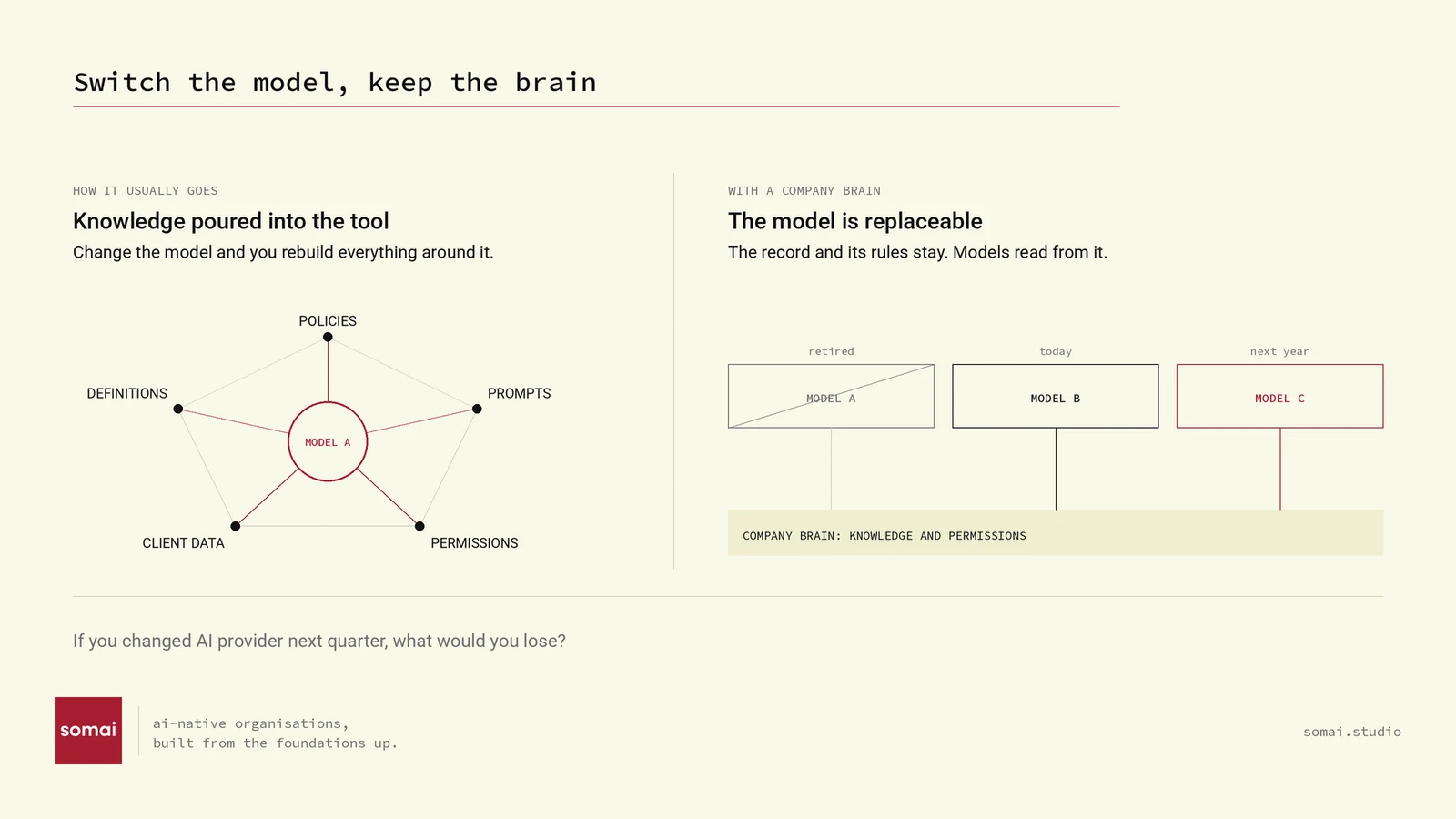
Every AI provider now publishes a retirement schedule. Anthropic’s documentation says it plainly: “As safer and more capable models launch, Anthropic regularly retires older ones.” It commits to “at least 60 days’ notice” before a public model is retired. One of its own models, Claude 3 Haiku, was retired in April this year, a little over two years after it launched. OpenAI publishes a similar page with shutdown dates for its older models.
None of this is a complaint. Models get better quickly, and providers can’t run every old version forever. But it does mean that any firm building on AI is building on something with a published end date.
Most firms are building in the wrong place
Look at how a typical 200-person firm has adopted AI over the last two years. A few teams have custom assistants in one vendor’s tool. Someone has uploaded the policy library into another. The sales team has a set of prompts tuned to a particular model’s quirks. The knowledge about how the firm works is spread across these places, shaped to fit each one.
Each is fine on its own. Together they create a quiet kind of lock-in. When a better model arrives, or a provider changes its prices, or a client asks where their data is processed, moving is expensive. Not because the model is hard to replace, but because the firm’s knowledge has been poured into the shape of the tool.
Separate the two things
There are two different things in any company AI setup, and they have very different lifespans.
The model is the engine. It reads, reasons and writes. It improves every few months and is replaced every year or two. You should expect to change it, and you should want to, because the next one will usually be better.
The knowledge is everything the model needs to be useful in your firm: your clients, your decisions, your policies, your definitions, who is allowed to see what. That builds up over years. It’s the part that makes an answer right for your firm rather than generically plausible.
The mistake is to store the second inside the first. When the knowledge lives in a vendor’s assistant, switching the engine means rebuilding the car.
What “keep the brain” looks like
A company brain keeps the knowledge on the firm’s side of the line. It is one governed record of what the company knows, owned by the company, with its own rules about who can see what. Models read from it. They don’t hold it.
That has some plain practical effects.
When a better model comes out, you point it at the same record and compare the answers. If they’re better, you switch. Nobody re-uploads anything or rewrites a hundred prompts.
When a provider retires the model you use, you have sixty days’ notice and a short job, not a project.
When a client asks which provider processes their information, you can answer, and you can change it if they need you to.
And the permissions stay with the record. The rule that only the finance team can see salary data isn’t a setting buried in one vendor’s tool, to be recreated in the next. It belongs to the firm.
“We’ll just pick the best vendor and stay”
This is a reasonable position, and for some firms it’s the right one. Picking one platform keeps things simple, and simplicity has real value in a firm without a large IT team.
But it assumes the best vendor today will still be the best vendor in three years, at a price you’re still happy with, with terms your clients still accept. The last three years of AI suggest that is a big assumption. The leading model has changed hands several times.
Choosing one vendor is fine. Storing your company’s knowledge in a form that only that vendor can read is the part worth avoiding.
Ask the switching question now
The useful test is simple. If you had to move to a different AI provider next quarter, what would you lose?
If the answer is “a few settings and some licences”, you’re in good shape. If the answer is “two years of our best people’s work”, the knowledge is in the wrong place, and the next retirement notice will show you.
Sources: Anthropic, model deprecations; OpenAI, deprecations. Both read 5 November 2026.