
Ask a capable model for a go-to-market plan, a product strategy or a positioning statement, and you will get something good. Clear structure, sensible priorities, no obvious mistakes. Then ask your competitor what they got.
It will be the same plan, even if they asked a different model.
Not word for word. But the same shape, the same priorities, the same safe conclusions. You both received the answer the model considers most likely, and the most likely answer is, by construction, the one closest to the middle.
The model returns the middle of the curve
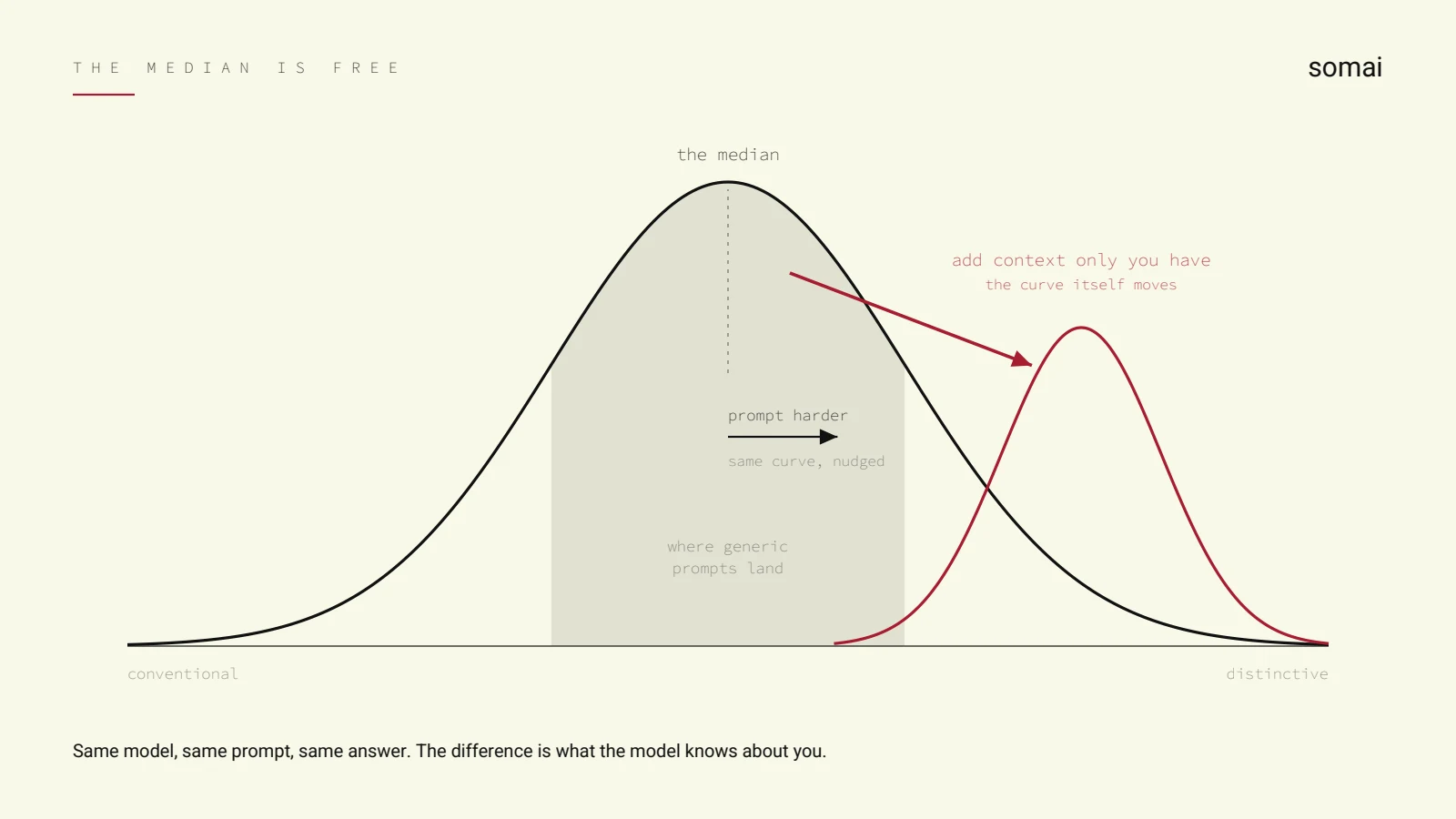
A language model learns from an enormous body of human writing, then produces the most plausible continuation of whatever you give it. Plot everything it could say in response to a request and you get something like a bell curve. A fat middle of conventional, defensible answers. Thin tails at either end, where the unusual ideas live.
The model’s default is the middle. That is what it was built to do.
Training then narrows it further. The fine-tuning that makes a model helpful and polite rewards answers that people rate highly, and people, it turns out, rate familiar answers highly. A Stanford paper presented at ICML this year traces this mode collapse to the preference data itself: human raters favour text that reads as typical, so the model learns to favour it too. The middle gets fatter.
The evidence for the result has hardened over the past year. A March 2026 study in PNAS Nexus put 22 models and around a hundred people through standard creativity tests. Individually, the models matched the humans for originality. Collectively, their answers were far more alike: in the authors’ words, “LLM responses mirror other LLM responses far more than humans do other humans.” A NeurIPS 2025 paper found the same across 26,000 real open-ended questions, and named it the Artificial Hivemind: a single model repeats itself, and, more strikingly, models from different labs converge on the same answers.
That second finding matters for anyone hoping to escape the average by switching tools. Your competitor’s model and yours were trained on much the same writing and tuned towards the same preferences. They meet in the middle.
The next model will not fix this
The natural assumption is that bigger, newer models will be more original. The research points the other way. A 2026 study accepted at ICML found that the loss of diversity during fine-tuning “worsens with scale”: the larger the model, the more its post-training pulls it towards the middle. Models are getting better at the average. That is not the same as getting further from it.
Prompting harder moves you less than you think
The usual response is to prompt better. Be bolder. Act as a contrarian strategist. Give me ten unconventional options.
It helps, a little. The PNAS Nexus authors tried exactly this, varying the system prompt and turning up the randomness setting, and found the spread of answers changed only modestly; pushed far enough, the output turned to gibberish before it turned original. A prompt that asks for creativity, with nothing else in it, can only draw on what the model already holds. Ask for unconventional and you get the average of unconventional, which is the set of contrarian ideas everyone else’s model is also producing.
A better instruction changes the question. It does not change what the model knows.
Context moves the curve itself
There is one input that changes the answer more than any instruction: information the model has never seen.
When you give the model your actual pipeline, the objections your customers raised last quarter, the deal you lost and why, the decision your board made in March, the most likely answer is no longer the world’s most likely answer. It is the most likely answer given your situation. The model is doing the same job, predicting the plausible continuation, but plausible is now anchored in your facts instead of everyone’s average.
This is the mechanism worth understanding. A model is reliable at compressing a lot of real material into a clear answer, and unreliable at expanding a thin prompt into specifics: it fills the gaps with the statistical average, delivered confidently. Thin context forces it to expand into that average. Rich context lets it compress instead. The uniqueness of the output can only come from the uniqueness of the input, because nothing else in the exchange is unique to you.
The industry has settled on a name for this over the past year: context engineering, the discipline of deciding what a model sees on every request. The name is new. The logic is old. The model is the same for you and your competitor, and the prompting tricks are on every LinkedIn feed. What is not shared is what your organisation knows: its history, its customers, its judgement, the reasons behind its decisions.
Sometimes the median is exactly what you want
None of this is an argument for making everything unique. Plenty of work should be average.
The supplier contract, the expenses policy, the standard onboarding email, routine code: you want these conventional, well-trodden and unsurprising. The median is the consensus of everything the model has read, and for commodity work the consensus is correct. Fighting it wastes time and adds risk. Take the average, check it, move on.
The trade-off is about where you spend your distinctiveness. Average your boilerplate. Push to the edge wherever the answer differentiates you: strategy, positioning, product decisions, the way you treat a customer. These are the places where landing on the same answer as everyone else is a cost.
Avoid the averages, unless the average is what you want.
Access is not context
If context is what moves the curve, the next problem is practical. The major assistants now connect to your drives, inboxes and calendars, and will search them when asked. That is progress, but access is not the same as context. A search returns fragments: the documents that happen to match the words in your question, whether or not they are current, and with the reasons behind them left out. Much of what makes your organisation distinctive was never written down at all. It sits in meeting rooms and in the heads of the people who were there.
The organisations that get off the middle of the curve consistently will be the ones that treat their own context as an asset: captured as the work happens, kept current, structured so a model can draw on it whole rather than in pieces. They will run the same models as everyone else and get answers no one else can get.
So the question is not whether your team uses AI. Everyone does. The question is what your AI knows that your competitor’s does not. If the answer is nothing, you are both getting the average answer.